Beyond the Crisis: Mission Amid Persecution 🌍

The great intervention for the Great Commission
Kate Azumah
Listen to this article
Musa,* the youth leader of a religious sect in the town sent letters threatening to kill Pa Johnson’s family and to burn down his house. Next, he reported Pa Johnson to the town’s government officials, and Pa Johnson was called into a meeting. At the meeting were clerics with Pa Johnson as the only Christian. When Pa Johnson greeted, the other clerics were so furious that none of them responded. The charges against Pa Johnson were read – he was converting their followers and claiming that Jesus is the only way to God – but God gave him wisdom to respond. After Pa Johnson spoke, the officials decided that he had done nothing wrong. In fact, one of them, who belonged to Musa’s religion, testified to the good work Pa Johnson’s ministry had accomplished in his own village.
But Musa was not placated. Pa Johnson shares, “Musa continued with the threats. He sent me a photo of Osama bin Laden with my picture beside it and the words, “You are next.” I replaced Osama’s photo with a picture of Jesus and returned it to Musa with the words, “you are next” (to be saved).” I kept praying for Musa until he began having dreams about Jesus. He came to me to learn more and we became friends. Musa is now a Christian leader who is also serving Jesus.” This is one of the many miracles Pa Johnson has witnessed in what he calls, “God’s great intervention for the Great Commission.”
Multiplying disciples
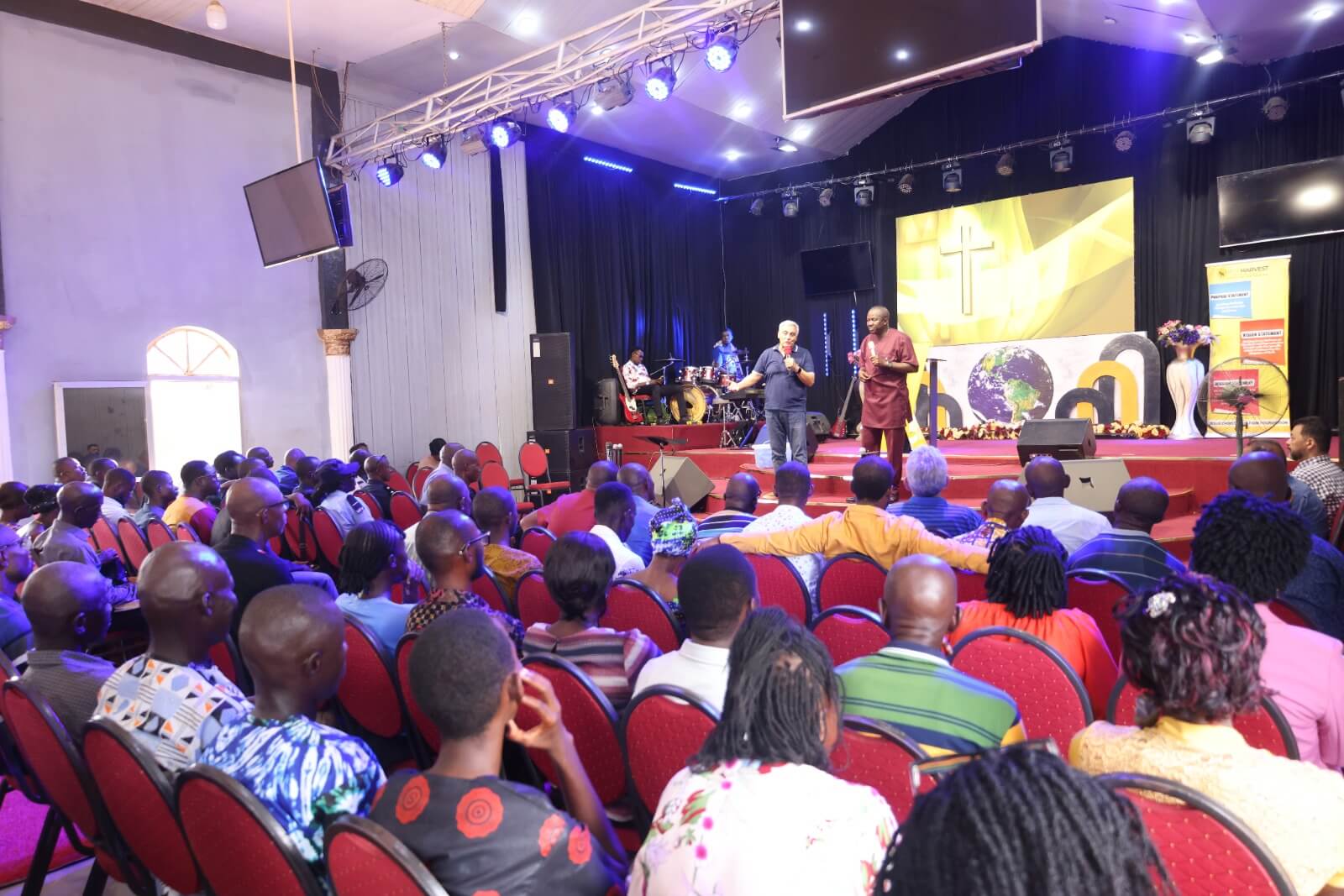
Rev. Dr. Shodankeh Johnson is the global team leader for New Harvest Global Ministries, a church that started about 30 years ago with the goal of reaching unreached peoples in non-Christian communities. “We started with the old way of planting churches through evangelistic crusades until we switched after 10 years to focus on making and multiplying disciples and churches. Now, we pray for the Lord to lay on our hearts a people group or nation that he wants us to reach. When we get the conviction, we send people into the community and find a person or family of peace.”
“Persons of peace are those whom God has already prepared to open the community to us. We build strong relationships with them and tell them about Jesus. We encourage them to invite other people and then we start a Discovery Bible Study (DBS) where we read the Scriptures with the community and discover God’s Word together. The study goes on for about five to ten weeks and then we baptize those who are willing to follow Jesus. Once we baptize some individuals and families, a church begins.”
“The new church may meet in a house or under a tree but from the onset, we create a leadership DBS group to train leaders for the young church. We also coach the members to reach others and to multiply disciples, disciple-makers, intercessors, leaders and churches. Once they understand the process, they replicate it. Our definition of success is not in the size of our church buildings but rather in how our disciples and churches are rapidly multiplying themselves.”
Using this strategy, New Harvest Global Ministries has planted several churches with rabbit DNA (multiplying quickly) – from small churches of seven to 20 members in restricted communities to those with up to 1,000 members in places where there is freedom of worship. “In everything we do, we have the principle of ‘touch not God’s glory’ – we don’t announce it but we let God take all the glory.”
Miracles for the gospel
Pa Johnson defines miracles as God’s divine work among us which he accomplishes directly by himself or indirectly through man. He says that no man has a monopoly on God, but because we are God’s masterpiece creation, he usually choses to do his miracles through people. “We are very open to miracles and we see God’s miracles in many ways,” he says.
“When it comes to the Great Commission, we have the miracle of soul-winning. Like Musa’s story, we have seen the most unlikely individuals, families and communities come to Jesus; people who previously hated Jesus and the Church. God has used dreams and revelations, or worked through our intercessors and disciple-makers to bring them to himself. We currently have many disciples and leaders who were once like Saul in the Bible. Today, they have become Pauls who are enduring the same kind of persecution they had meted out to us.”
“Another miracle is what God does through prayer. We have a prayer house for chain prayers from Tuesday to Saturday. Teams come to pray every three hours. We have seen God heal people with severe mental illness and others whose situations were written off by doctors. One woman came after the doctors said her organs were shutting down and she wouldn’t survive. We kept praying for her and one day, she woke up with every part of her body functioning normally. Since her healing, she has given birth to two children.”
“A baby who could not talk was abandoned at the prayer house. Every morning, we would pray for him. That child is now an adult who preaches the Word of God, and goes to hospitals to pray for people. Other miracles are people delivered from demonic possession. All we do is to lay hands on people and pray. We tell them God is the healer, so we are not pressured to make anything happen. When God heals, we give him the glory, and when healing doesn’t happen, we keep trusting God. We don’t take money when we pray for people because Jesus instructs us to freely give as we have freely received.”
“We have witnessed God raising individuals and families from generational poverty. When we notice a community lagging behind in development, we mobilize the community members to pray for God’s intervention. Soon, they begin to see development coming to their towns.”
Why miracles?
“It is erroneous to think that the Great Commission can be done without the great intervention of miracles. Although we may have human hands laid on us, it is God who is sending us. If God doesn’t draw the people to himself, or dispossess the powers that keep them in spiritual bondage, our work will be futile. The strongman Jesus mentioned in Mark 3:27 could be cultural, intellectual and economic barriers that keep people from coming to the Lord. We need God’s miracles to overcome them.”
“We also need God’s intervention for the labourers to go, just as Jesus instructed us to pray. Sometimes, God sends the most unlikely people. Some people never went to school but God works through them. Miracles accelerate God’s work. We once sent two people to a community, and when they arrived, the chief’s senior wife was at the point of death. They requested permission to pray for her and as they did, she sneezed and got up. That miracle caused the chief to open his community to the gospel and today, we have planted more than 27 churches in the area.”
Pitfalls and encouragement
Pa Johnson acknowledges that not all miracles are from God. The enemy creates counterfeits too. “Be careful about using any power that operates outside God’s Word. If you are on the mission field and no miracles are happening, it doesn’t mean God is not with you. There are times when God is silent. It is dangerous to give up on God that it cannot work or that miracles will not happen. Some labour faithfully with no results for many years before a bountiful harvest suddenly comes. If things are not working, mobilize more people to pray with you. Don’t give in to frustration, or the desire to make money and a name for yourself. God called us to the Great Commission of winning souls and not the “Great Commotion” of fighting each other for supremacy and who has the biggest church or private jet.”
To witness God’s intervention in missions, Pa Johnson advises that everything be founded on God’s Word and prayer. “Prioritize disciple-making and multiplication over gathering crowds. Initiate collaborations with likeminded churches and leaders to advance the Great Commission, and pray for spiritual gifts and the fruit of the Spirit.”
The African mission movement is growing. Shall we do it in our own strength or depend on God to accomplish his mission his way and by his power?